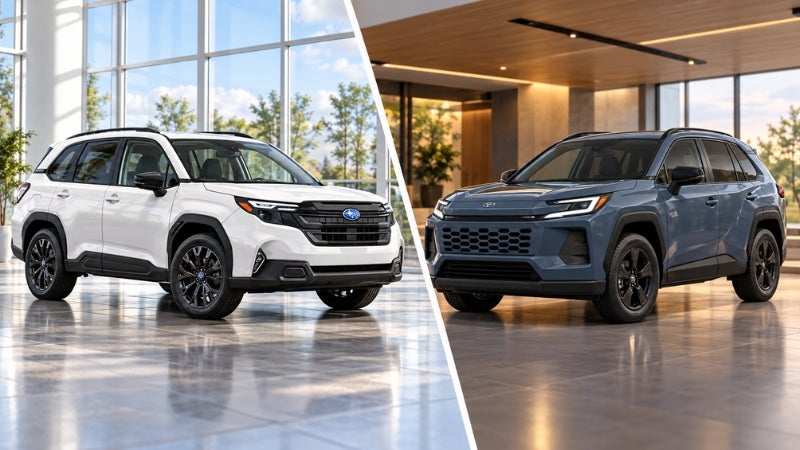
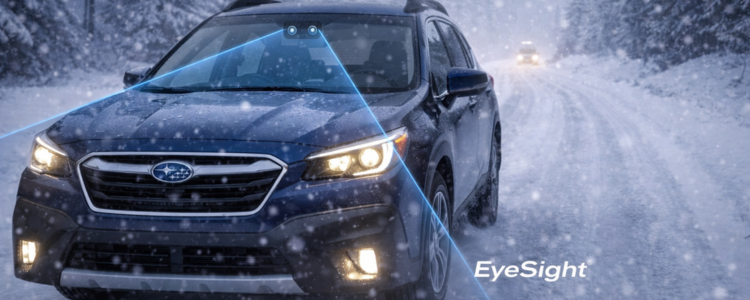
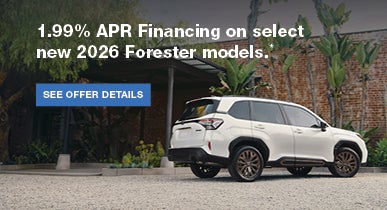
2026 Subaru Forester vs. 2026 Toyota RAV4 For Milwaukee drivers, the 2026 Subaru Forester is the stronger winter pick: every Forester comes standard with Symmetrical All-Wheel Drive and at least 8.7 inches of ground clearance. The 2026 Toyota RAV4 wins on fuel economy, with hybrid models rated up to 47 MPG city. Both are five-passenger compact SUVs built around versatility, cargo space, and everyday practicality. The Forester Wilderness raises ground clearance to 9.3 inches. The RAV4 has moved to an all-electrified lineup of hybrid and plug-in hybrid models, offered with front-wheel drive or all-wheel drive depending on trim. The better choice depends on whether you prioritize standard AWD and Wisconsin-ready capability, or the RAV4's higher fuel economy and plug-in hybrid option. If the Forester fits, see every 2026 Subaru Forester for sale at Subaru City of Milwaukee. 2026 Subaru Forester vs. 2026 Toyota RAV4: Quick Comparison Feature 2026 Subaru Forester 2026 Toyota RAV4 Seating Capacity 5 passengers 5 passengers Drivetrain Symmetrical AWD standard FWD or AWD, depending on trim Standard Ground Clearance 8.7 in. 8.1 in. on most trims Maximum Ground Clearance 9.3 in. (Wilderness) 8.5 in. (Woodland) Powertrains Gas or hybrid Hybrid or plug-in hybrid (no gas-only model) Gas Model Fuel Economy Up to 26 city / 33 hwy MPG Not offered Best Hybrid MPG 35 MPG (EPA est.) Up to 47 MPG city (FWD) Maximum Cargo Volume Up to 74.4 cu. ft. Up to 70.4 cu. ft. Maximum Towing Capacity 3,500 lbs. (Wilderness) 3,500 lbs. (select AWD trims) Standard Safety Suite EyeSight® Driver Assist Technology Toyota Safety Sense™ 4.0 Off-Road Model Forester Wilderness RAV4 Woodland The Forester includes all-wheel drive on every model, while the RAV4 gives shoppers more electrified-powertrain choices. If you want something smaller, compare the Subaru Crosstrek vs. Forester. Does All-Wheel Drive Cost Extra on the Forester or RAV4? The least expensive 2026 RAV4 starts at $31,900 for a front-wheel-drive hybrid, according to Toyota. Other RAV4 configurations offer all-wheel drive. Every 2026 Forester already includes Symmetrical All-Wheel Drive, so there is no AWD upgrade to price in. Subaru City of Milwaukee posts current pricing and finance offers on every Forester and Forester Hybrid. Check current Subaru Forester deals, including financing offers, before you visit. Which SUV Has More Passenger and Cargo Space? Both the 2026 Forester and RAV4 seat five and provide flexible cargo areas for commuting, grocery runs, family trips, and weekend travel. A 2026 Forester Premium at Subaru City of Milwaukee lists 106.6 cubic feet of passenger volume, 43.3 inches of front legroom, and 39.4 inches of second-row legroom. That configuration provides 27.5 cubic feet of cargo space behind the second row and 69.1 cubic feet behind the first row. Subaru City of Milwaukee lists up to 74.4 cubic feet of cargo volume for the Forester Base, so maximum capacity varies by configuration. The 2026 RAV4 lists 98.9 cubic feet of passenger volume, 37.8 cubic feet of cargo space behind the second row, and up to 70.4 cubic feet with the rear seats folded. Interior Space 2026 Subaru Forester 2026 Toyota RAV4 Seating Capacity 5 5 Passenger Volume 106.6 cu. ft. (Premium) 98.9 cu. ft. Front Legroom 43.3 in. 41.0 in. Rear Legroom 39.4 in. 37.8 in. Cargo Behind Rear Seats 27.5 cu. ft. (Premium) 37.8 cu. ft. Maximum Cargo Volume Up to 74.4 cu. ft. Up to 70.4 cu. ft. The RAV4 has more cargo room behind the rear seats. The Forester offers more passenger volume, more front and rear legroom, and more total cargo space with the seats folded. For families who regularly carry adults or older children in the second row, the Forester's extra legroom may matter as much as the cargo numbers. Need even more cargo length? See our Subaru Outback vs. Forester comparison. Forester vs. RAV4 Performance The 2026 Forester and RAV4 take very different approaches to performance. Gas-powered 2026 Forester inventory at Subaru City of Milwaukee uses a 2.5-liter SUBARU BOXER® four-cylinder engine paired with a continuously variable transmission. Every Forester includes Symmetrical All-Wheel Drive. Subaru City of Milwaukee lists the 2026 Forester Hybrid at 194 combined system horsepower and standard Symmetrical All-Wheel Drive. Browse each Subaru Forester Hybrid for sale in Milwaukee. The 2026 Toyota RAV4 is hybrid-only. Toyota rates the RAV4 Hybrid at 226 net combined horsepower with front-wheel drive and 236 with all-wheel drive. The RAV4 Plug-in Hybrid produces 324 net combined horsepower. Performance 2026 Subaru Forester 2026 Toyota RAV4 Gas Engine 2.5L BOXER 4-cylinder Not offered Hybrid Output 194 combined hp 226 hp FWD / 236 hp AWD Plug-in Hybrid Not offered 324 combined hp Drivetrain AWD standard FWD or AWD, depending on trim The RAV4 Hybrid offers more horsepower than the Forester Hybrid. The Forester's defining difference is that all-wheel drive comes standard, whether you choose the gas Forester or the Forester Hybrid. Which Is Better for Milwaukee Winters? Winter capability is one of the most important differences for Wisconsin drivers, and it's where the Forester has the clearest advantage. Every 2026 Forester includes Symmetrical All-Wheel Drive. Standard Forester models provide 8.7 inches of ground clearance, useful for snow-covered side streets, unplowed parking lots, driveways, and winter commutes on I-94 and I-43. The Forester Wilderness raises ground clearance to 9.3 inches and adds a raised suspension, Yokohama GEOLANDAR® all-terrain tires, and Dual-Function X-MODE® with Hill Descent Control. The RAV4 offers all-wheel drive on select models, not across the lineup. Toyota lists 8.1 inches of ground clearance on most 2026 RAV4 trims, while the adventure-oriented Woodland increases that to 8.5 inches. Winter Capability 2026 Subaru Forester 2026 Toyota RAV4 All-Wheel Drive Standard Available, depending on trim Standard Ground Clearance 8.7 in. 8.1 in. on most trims Maximum Ground Clearance 9.3 in. (Wilderness) 8.5 in. (Woodland) Traction Modes Dual-Function X-MODE® with Hill Descent Control (Wilderness) Drive modes vary by trim Rugged Model Wilderness Woodland For Milwaukee drivers who don't want to wonder whether they picked the right drivetrain for winter, the Forester keeps it simple: AWD is already standard. Learn more in our guide to AWD vs. FWD in snow. Which Can Tow More? At the top end, it's a tie: the 2026 Forester Wilderness and most all-wheel-drive RAV4 trims are both rated to tow up to 3,500 pounds. Subaru City of Milwaukee lists the Forester Wilderness with a towing capacity of 3,500 pounds, noting that capacity varies by trim and trailer brakes may be required. On the RAV4, the 3,500-pound rating applies to all-wheel-drive SE, XLE Premium and Woodland models; Toyota lists the RAV4 LE at 1,750 pounds. Towing 2026 Subaru Forester 2026 Toyota RAV4 Maximum Towing 3,500 lbs. (Wilderness) 3,500 lbs. (AWD SE, XLE Premium, Woodland) Lower Rating Varies by trim 1,750 lbs. (LE) Towing limits depend on configuration and equipment, so always confirm the rating for the exact vehicle before towing. Regular towing also adds wear, so follow the Subaru Forester maintenance schedule. Which Gets Better Gas Mileage? The RAV4 wins on fuel economy; the Forester Hybrid is the choice if you want better mileage without giving up standard AWD. Subaru City of Milwaukee lists the conventional 2026 Forester at up to 26 MPG city and 33 MPG highway, with all-wheel drive standard. The Forester Wilderness is rated at 24 city and 28 highway. The 2026 Forester Hybrid gets 35 MPG and offers up to 581 miles of driving range, with standard Symmetrical All-Wheel Drive. Front-wheel-drive RAV4 Hybrid models are rated up to 47 MPG city and 40 MPG highway. All-wheel-drive RAV4 trims are rated lower, down to 41 MPG city on the Woodland. Fuel Economy 2026 Subaru Forester 2026 Toyota RAV4 Gas Model Up to 26 city / 33 hwy MPG Not offered Hybrid 35 MPG, up to 581-mile range (Forester Hybrid, AWD) Up to 47 city / 40 hwy MPG (RAV4 Hybrid, FWD) AWD Standard? Yes No, depending on trim If maximum MPG is your top priority, the RAV4 Hybrid has the edge. If you want hybrid efficiency while keeping standard Subaru AWD, the Forester Hybrid is the alternative. Replacing an older, thirstier SUV? Check your current vehicle's trade-in value online first. Forester vs. RAV4 Technology Both compact SUVs offer modern infotainment and connectivity. Subaru City of Milwaukee lists wireless Apple CarPlay® and Android Auto™ integration on the 2026 Forester, an 11.6-inch Multimedia Plus system on the Premium, and an 11.6-inch Multimedia system with Navigation on the Touring. The Touring also adds a 360-degree surround view monitor. Every Forester Hybrid trim gets a 12.3-inch fully digital instrument cluster. The RAV4 LE and XLE Premium use a 10.5-inch Toyota Audio Multimedia touchscreen, while the XSE, Limited and GR SPORT get a 12.9-inch screen. A 12.3-inch digital gauge cluster is standard on every RAV4. Technology 2026 Subaru Forester 2026 Toyota RAV4 Touchscreen 11.6 in. (Premium, Touring) 10.5 in.; 12.9 in. on upper trims Wireless Apple CarPlay® / Android Auto™ Yes Available 360-Degree Camera Available Available Digital Instrument Cluster 12.3 in. on every Forester Hybrid 12.3 in. standard The RAV4 has the larger maximum touchscreen and a standard digital cluster. The Forester offers an 11.6-inch display, wireless smartphone integration, and an available 360-degree surround view monitor. Forester vs. RAV4 Safety Features Every 2026 Forester comes with EyeSight® Driver Assist Technology. Subaru City of Milwaukee lists EyeSight features including Pre-Collision Braking, Lane Departure and Sway Warning, Advanced Adaptive Cruise Control with Lane Centering, Automatic Emergency Steering and Pre-Collision Throttle Management. Depending on trim, the Forester adds Blind-Spot Detection (Sport and Limited), DriverFocus® Distraction Mitigation and a 360-degree surround view monitor (Touring). Every 2026 RAV4 comes with Toyota Safety Sense™ 4.0, including Pre-Collision System with Pedestrian Detection, Full-Speed Range Dynamic Radar Cruise Control, Lane Departure Alert with Steering Assist, Lane Tracing Assist, and Proactive Driving Assist. Blind Spot Monitor and a Panoramic View Monitor are available depending on trim. Both SUVs offer comprehensive active-safety technology. Compare the exact trim you're considering, since available systems differ across each lineup. Driver-assist systems still depend on traction. Our guide to the best tires for Subaru Forester models covers what to run through a Wisconsin winter. 2026 Subaru Forester Trim Levels 2026 Subaru Forester Trim Key Difference Base Standard AWD, EyeSight®, 8.7-in. clearance, 17-in. alloy wheels, raised roof rails Premium 11.6-in. Multimedia Plus system, power moonroof, 10-way power driver's seat, All-Weather Package Sport 19-in. bronze-finish wheels, SI-DRIVE, StarTex® upholstery, Blind-Spot Detection, available Onyx Edition Wilderness 9.3-in. clearance, all-terrain tires, Dual-Function X-MODE®, 3,500-lb. towing Limited Leather-trimmed upholstery, power rear gate, Blind-Spot Detection Touring Navigation, 360-degree surround view monitor, heated front and rear seats, DriverFocus® Subaru City of Milwaukee also offers the Forester Hybrid in Premium Hybrid, Sport Hybrid, Limited Hybrid and Touring Hybrid trims, all with Symmetrical All-Wheel Drive. That gives Forester shoppers a choice between gas and hybrid powertrains without giving up standard AWD. Prefer a lower monthly payment? See current Subaru Forester lease deals. 2026 Toyota RAV4 Trim Levels Toyota offers the 2026 RAV4 Hybrid in LE, SE, XLE Premium, Woodland, XSE, and Limited trims, plus a RAV4 Plug-in Hybrid that includes the performance-focused GR SPORT. The Woodland is the closest RAV4 counterpart to the Forester Wilderness, with standard all-wheel drive, 8.5 inches of ground clearance, and adventure-focused equipment. Subaru Forester vs. Toyota RAV4: Which Is Better? No compact SUV is automatically better for every driver. The 2026 Toyota RAV4 may be a better fit if you prioritize maximum fuel economy, more cargo room behind the second row, more horsepower, or a plug-in hybrid option. The 2026 Subaru Forester makes a strong case for Milwaukee drivers who prioritize standard all-weather capability, passenger space, and ground clearance. Every Forester includes Symmetrical All-Wheel Drive, standard models offer 8.7 inches of ground clearance, and the Wilderness raises that to 9.3 inches and adds up to 3,500 pounds of towing. Choose the 2026 Subaru Forester If You Want… Choose the 2026 Toyota RAV4 If You Want… Standard Symmetrical All-Wheel Drive Higher hybrid MPG AWD without paying for an upgrade A plug-in hybrid option 8.7-in. standard ground clearance More cargo room behind the rear seats 9.3-in. Wilderness capability Woodland adventure trim More passenger room and legroom More hybrid horsepower A gas or hybrid choice, both with AWD Front-wheel drive to lower the price For Milwaukee and southeastern Wisconsin drivers, the Forester's defining advantage is that winter-ready AWD is built into the entire lineup rather than something you need to add. Shopping on a tighter budget? Browse every used Subaru Forester for sale at Subaru City of Milwaukee. Test Drive a 2026 Subaru Forester at Subaru City of Milwaukee The best way to decide whether the 2026 Forester is right for you is to drive one. At Subaru City of Milwaukee, you can compare gas and hybrid Forester models across the Base, Premium, Sport, Wilderness, Limited, and Touring trims and see how the features change through the lineup. Whether you need a daily commuter, a family SUV, better fuel economy, or more capability for Wisconsin winters, the Forester combines flexible passenger space with standard Symmetrical All-Wheel Drive and generous ground clearance. Browse every new Subaru Forester for sale at Subaru City of Milwaukee, or visit us at 4640 S 27th St, Milwaukee, WI 53221. Call 414-488-1064 to schedule a test drive. Frequently Asked Questions Does the Subaru Forester or Toyota RAV4 come standard with AWD? Every 2026 Subaru Forester comes standard with Symmetrical All-Wheel Drive. The 2026 Toyota RAV4 is offered with front-wheel drive or all-wheel drive, depending on trim. Which has more ground clearance, the Forester or RAV4? The standard 2026 Forester has 8.7 inches of ground clearance, compared with 8.1 inches on most RAV4 trims. The Forester Wilderness raises clearance to 9.3 inches, while the RAV4 Woodland has 8.5 inches. Which gets better gas mileage, the Forester or RAV4? The RAV4 does. Front-wheel-drive 2026 RAV4 Hybrid models are rated up to 47 MPG city and 40 MPG highway. Subaru City of Milwaukee lists the Forester Hybrid at 35 MPG and the gas Forester at up to 26 MPG city and 33 MPG highway, all with standard AWD. Which has more passenger and cargo space, the Forester or RAV4? The Forester Premium has 106.6 cubic feet of passenger volume versus 98.9 for the RAV4, plus more front and rear legroom. The RAV4 has more cargo room behind the rear seats (37.8 vs. 27.5 cubic feet), but the Forester offers more total cargo space with the seats folded (up to 74.4 vs. 70.4 cubic feet). Can the Subaru Forester tow as much as the Toyota RAV4? Yes, at the top end. The 2026 Forester Wilderness tows up to 3,500 pounds, matching all-wheel-drive RAV4 SE, XLE Premium, and Woodland models. The RAV4 LE is rated at 1,750 pounds. Is the Subaru Forester good for Wisconsin winters? Yes. Symmetrical All-Wheel Drive is standard on every 2026 Forester, and standard models have 8.7 inches of ground clearance. For deeper snow, the Forester Wilderness adds 9.3 inches of clearance, all-terrain tires and Dual-Function X-MODE® with Hill Descent Control. To compare the whole lineup, see our guide to the best Subaru for snow. Sources: Subaru City of Milwaukee, 2026 Subaru Forester, 2026 Subaru Forester Hybrid, 2026 Subaru Forester Wilderness, Subaru hybrid vehicles and Subaru EyeSight; Toyota USA Newsroom, 2026 RAV4. Specifications as of October 2026 and subject to change.