CLOSED THANKSGIVING

BLACK FRIDAY EXTENDED SALES HOURS 9AM-8PM

Blog / Milwaukee Subaru Service

The Importance of Regular Oil Changes and How to Know When It’s Time

oil change blog banner

Keeping your vehicle in optimal condition requires routine maintenance, and one of the simplest yet most essential tasks is a regular oil change. Engine oil serves as the lifeblood of your car, ensuring that all moving parts operate smoothly, reducing friction, and preventing overheating. Neglecting oil changes can lead to costly repairs and reduced engine performance. Let’s explore why regular oil changes are crucial and how to know when it’s time for one.

Why Are Oil Changes Important?

  1. Lubrication: The engine consists of numerous moving parts, such as pistons, valves, and the crankshaft. Oil ensures these components glide smoothly, reducing wear and tear.
  2. Temperature Regulation: As oil circulates, it absorbs heat from the engine, preventing overheating and ensuring efficient operation.
  3. Debris Removal: Over time, dirt, metal particles, and other contaminants can accumulate in the oil. Regular changes prevent this debris from damaging your engine.
  4. Prolongs Engine Life: Clean oil keeps your engine running efficiently, reducing the risk of costly breakdowns and extending the life of your vehicle.

Signs It’s Time for an Oil Change

  1. Dashboard Oil Light: Modern vehicles are equipped with an oil light that alerts you when it’s time for a change. Don’t ignore this warning.
  2. Dark or Dirty Oil: Fresh oil has a translucent amber color. Over time, it darkens and becomes murky. Check your oil using the dipstick—if it’s dark, it’s time for a change.
  3. Unusual Engine Noise: Insufficient or old oil can cause your engine to become louder, producing knocking or grinding sounds.
  4. Burning Oil Smell: A strong smell of burning oil may indicate a leak or that the oil is breaking down under high heat.
  5. Decline in Performance: If your vehicle’s acceleration feels sluggish or the fuel efficiency decreases, old oil might be the culprit.

How Often Should You Change Your Oil?

The frequency of oil changes depends on your vehicle’s make and model, driving habits, and the type of oil used. Traditional advice suggests every 3,000 miles or three months, but many modern vehicles can go 5,000 to 7,500 miles or more. Synthetic oils often allow for even longer intervals. Check your owner’s manual or consult with a trusted mechanic for the best schedule.

Choosing the Right Oil

Using the right type of oil is crucial. Options include conventional, synthetic, synthetic blend, and high-mileage oil. Factors like your vehicle’s age, driving conditions, and manufacturer recommendations will determine the best choice. At Schlossmann Subaru City of Milwaukee, our expert technicians can help you select the perfect oil for your car.

DIY vs. Professional Oil Changes

While some drivers prefer to change their own oil, having it done professionally ensures the job is completed correctly. Technicians at Schlossmann Subaru City of Milwaukee not only change your oil but also inspect your vehicle for other potential issues, giving you peace of mind.

Schedule Your Oil Change Today

Regular oil changes are an investment in the longevity and performance of your vehicle. If you’re due for an oil change or unsure about your vehicle’s needs, the team at Schlossmann Subaru City of Milwaukee is here to help. Schedule an appointment online or visit one of our service centers to keep your car running smoothly.


Taking care of your car starts with proper maintenance. Don’t let a simple oil change turn into a costly repair. Stay proactive and drive with confidence!

Posted in:

Related Posts

subaru cvt fluid change

Subaru CVT Fluid Change: Does Your Subaru Need One? What Milwaukee Drivers Should Know

Subaru CVT Fluid Change: Does Your Subaru Need One? What Milwaukee Drivers Should Know Subaru’s maintenance schedule calls for regular CVT fluid inspections, while replacement guidance depends on your model year and driving conditions. If you’re wondering whether your Subaru needs a fluid change, start with its specific maintenance schedule and service history. A Subaru technician can inspect the vehicle and explain what makes sense for it. That can help settle the “lifetime fluid” debate. “Lifetime” doesn’t mean every vehicle has the same needs forever. Here’s what Milwaukee drivers should know before scheduling a Subaru CVT fluid change. Quick answer: When Should Subaru CVT Fluid Be Changed? No single mileage interval applies to every Subaru CVT. Follow the maintenance schedule for your vehicle’s model year and ask a Subaru service professional to consider its driving conditions and service history. If you notice a change in how the transmission behaves, schedule an inspection instead of relying on a fluid-change interval alone. What Does CVT Fluid Do In a Subaru? Many automatic Subaru models use a Lineartronic continuously variable transmission, or CVT. Instead of shifting between a fixed set of gears like a conventional automatic, a CVT varies its gear ratio as the vehicle accelerates. In a typical CVT design, a chain or belt moves between pulleys that can change their effective size. The fluid does more than lubricate moving parts. It helps the transmission operate as designed, including managing friction and pressure. Think of it like cartilage in a knee: it helps parts move and work together smoothly, while doing a job ordinary automatic transmission fluid may not be designed to do. That’s why the right fluid matters. Subaru uses different CVT fluids across vehicles and model years. CVTF-II is one example, but it is not a universal specification for every Subaru. The correct fluid depends on the vehicle, so the shop should confirm it for your car before servicing it. Does Subaru Recommend Changing CVT Fluid? Subaru’s maintenance schedule is vehicle-specific. For some vehicles, the schedule lists CVT fluid as an item to inspect at set intervals; an inspection does not automatically mean it is due for replacement. Subaru directs owners to the maintenance booklet or MySubaru account for the schedule that applies to their vehicle. Subaru’s maintenance guidance explains that scheduled service depends on the vehicle and the interval it reaches first. What your schedule or situation says What to do The booklet lists a CVT fluid inspection Have the fluid inspected at the listed interval. Your driving or towing habits may count as severe use Ask Subaru City of Milwaukee to check the severe-use guidance for your model year. You don’t know the service history or notice a change in how it drives Book an inspection so a technician can assess the vehicle. Check the exact maintenance intervals against your Subaru’s booklet or a maintenance schedule lookup. Don’t assume a schedule for another model year, or an online mileage recommendation, applies to your vehicle. So, is Subaru CVT fluid “lifetime”? That phrase can be misleading. Subaru’s owner guidance directs drivers to the vehicle-specific maintenance schedule, and inspection or replacement recommendations can depend on the vehicle and how it is used. The best answer for your car comes from its schedule, service history, and inspections as needed. How Often Should You Change Subaru CVT Fluid? There isn’t one interval that fits every Subaru. The right question is: What does this vehicle's schedule say, and what has it been asked to do? An Outback, Forester, or Crosstrek may have different maintenance guidance depending on model year, transmission, and driving conditions. Subaru City of Milwaukee’s service team can review your vehicle information and explain whether the schedule calls for an inspection or a fluid service. We don’t use a made-up universal interval in place of the manufacturer’s guidance. If you’re unsure what was done before you bought the car, bring whatever service records you have or ask us to check the vehicle’s available history. Why Milwaukee Driving Can Affect CVT Maintenance Milwaukee driving can include freezing temperatures, short trips, traffic, and, for some drivers, towing trips Up North. These conditions are useful context when discussing maintenance with a technician. They should not be treated as a substitute for the severe-use definitions in your particular Subaru booklet. Cold starts and repeated short trips can mean the vehicle has less time to reach normal operating conditions. Stop-and-go travel on I-94 or I-894 adds frequent changes in speed and load. Towing a camper or boat also places different demands on a vehicle than routine commuting. Tell the service team how you use your Subaru, especially if you tow, frequently drive short distances, or travel in extreme weather. That information helps them check the correct guidance for your model. For more winter-driving tips, see our guide to warming up your Subaru in winter. Signs Your CVT May Need Attention You can’t diagnose a CVT problem from one symptom alone. If you notice a new or worsening change in how your Subaru drives, schedule an inspection rather than assuming the fluid is the cause: Shuddering or juddering as you pull away from a stop A new whining or droning sound Hesitation when accelerating A delay when shifting into Drive or Reverse A transmission or check-engine warning light These symptoms may have multiple possible causes. A technician can inspect the vehicle, retrieve diagnostic information when needed, and recommend the next step. Some Subaru models do not have a traditional transmission-fluid dipstick, so checking the level may require a shop procedure. What happens during a CVT fluid service at Subaru City of Milwaukee? The first step is understanding the vehicle’s concerns and service history. Subaru City of Milwaukee of Milwaukee offers a complimentary video inspection, so the service team can show you findings and discuss recommended work before moving forward. Learn about Subaru City of Milwaukee of Milwaukee’s service inspections and amenities. If a CVT fluid service is appropriate, the technician follows the procedure and fluid specification for your Subaru. A drain-and-fill service removes and replaces a measured portion of fluid; it is different from a complete transmission repair. The level-setting procedure can depend on the vehicle and fluid temperature, so it should be performed using the correct service information and equipment. Ask the service advisor how long your appointment is expected to take. The time can vary based on the vehicle, the requested inspection, and any additional diagnosis. Subaru City of Milwaukee also offers complimentary pickup and delivery, subject to service-area and scheduling details. How Much Does a Subaru CVT Fluid Change Cost? The price depends on your Subaru’s model year, transmission, fluid specification, and the work required. An inspection, a fluid service, and diagnosis of a transmission concern are different jobs, so the cost can vary. For a current estimate, contact Subaru City of Milwaukee with your vehicle’s year, model, and mileage. The team can check the correct service and explain the estimate before work begins. You can also review the current Subaru City of Milwaukee service specials to see whether an applicable offer is available. Avoid comparing estimates without checking what each one includes. Confirm the fluid specification, service procedure, and whether diagnostic work or other parts are included. Is Your CVT Still Under Warranty? Subaru’s new-vehicle powertrain warranty generally covers the engine, transmission, and all-wheel-drive system for five years or 60,000 miles, whichever comes first; confirm the terms that apply to your vehicle in its warranty materials. Some model years may also be covered by a separate CVT warranty extension or other program, with eligibility depending on the vehicle. If you’re concerned about a transmission issue, check coverage before authorizing a repair. Subaru City of Milwaukee can help review your VIN and available coverage. A warranty or extension does not automatically mean every concern or service is covered, so ask the service team to explain the applicable terms. In Summary A Subaru CVT fluid change isn’t governed by one universal mileage interval. Check the schedule for your specific vehicle, share how you drive it, and have a technician inspect it if you notice symptoms or don’t know its service history. Contact Subaru City of Milwaukee, call 414-488-1064 or visit 4640 S 27th St, Milwaukee, WI 53221. The service team can review your vehicle, discuss your options, and help you schedule service. Frequently Asked Questions (FAQs) Does Subaru CVT fluid need to be changed? It depends on the vehicle’s model year, maintenance schedule, driving conditions, and service history. Follow your Subaru's schedule and have the fluid inspected as needed. Does Subaru recommend changing CVT fluid? Subaru’s recommendation is vehicle-specific. Your Warranty & Maintenance Booklet or MySubaru account can show the applicable schedule; a technician can help interpret it for your driving conditions. How do you check Subaru CVT fluid? Many Subaru models do not have a traditional CVT-fluid dipstick. Checking the level can require a model-specific procedure, so ask a service professional to inspect it. What color is Subaru CVT fluid? Fluid color alone cannot confirm whether the fluid is correct or whether the transmission is healthy. Subaru uses different fluids across vehicles, so rely on the vehicle’s specification and a professional inspection rather than color alone. How much does it cost to change CVT fluid on a Subaru? The cost depends on your model, model year, fluid, and service procedure. Contact Subaru City of Milwaukee with your vehicle information for a current estimate.

Essential Winter Prep for Subaru Owners in Milwaukee

Essential Winter Prep for Subaru Owners in Milwaukee

How to Prepare Your Subaru Before the First Snowstorm Hits Milwaukee winters arrive fast — one week you’re driving comfortably down I-94, and the next you’re scraping ice at 6am wondering when the roads turned into a skating rink. Subaru owners know their vehicles are built for winter, but proper preparation is the key to safe, confident driving all season long. This guide covers the core pre-winter steps every Subaru owner should take to make sure their vehicle is ready for whatever Wisconsin weather throws at it. ❄️ 1. Upgrade Your Tires for Real Winter Traction Subaru winter tires Milwaukee, winter driving Subaru All-wheel drive is amazing, but traction starts with the tires themselves. Milwaukee’s lake-effect snow and icy mornings demand grip. What to do now: Consider installing winter tires for better traction Maintain a tread depth of 6/32" or more Check tire pressure weekly (cold lowers PSI quickly) Pro Tip: AWD gets you moving — winter tires help you stop. You need both. 🔋 2. Test Your Battery Before Temperatures Drop Subaru winter maintenance Milwaukee Nothing derails a morning like a weak battery in freezing temperatures. Milwaukee’s cold puts extra strain on older batteries. Before winter hits: Get a battery load test Replace your battery if it’s 3–5 years old Clean corrosion on terminals A strong battery prevents those dreaded “click… click… nothing” moments on sub-zero mornings. 🧊 3. Check & Top Off Your Subaru’s Fluids Your Subaru works harder during winter, so the right fluids make a major difference. Coolant/Antifreeze: Protects your engine in deep freezes Oil: Some Subaru engines benefit from specific viscosities in cold weather Windshield washer fluid: Use a winter blend to avoid frozen spray nozzles Make fluid checks part of your early-winter routine. 👀 4. Improve Winter Visibility Milwaukee roads stay coated in slush and salt for months, making visibility a safety priority. Winter visibility checklist: Install winter wiper blades Replace your rear wiper (Outback, Forester, Crosstrek) Test front & rear defrosters Seeing clearly is one of the easiest ways to prevent winter accidents. 🌨️ Get Winter-Ready at Schlossmann Subaru City of Milwaukee With these essential steps, your Subaru will be ready for the challenges of Wisconsin winter driving. If you want professional help: Schedule your Subaru Winter Prep Appointment today and stay ahead of the first big storm. Stay tuned for Blog #2: Winter Driving & On-the-Road Safety Tips for Subaru Owners in Milwaukee.

Subaru Forester vs. Toyota RAV4

Subaru Forester vs. Toyota RAV4

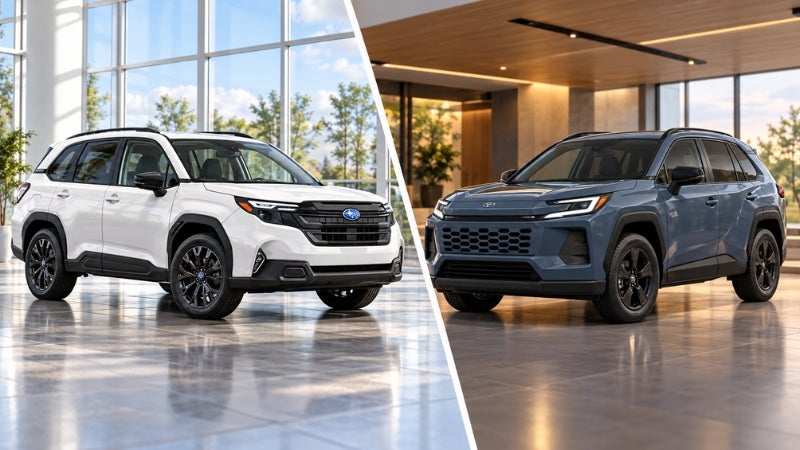
2026 Subaru Forester vs. 2026 Toyota RAV4 For Milwaukee drivers, the 2026 Subaru Forester is the stronger winter pick: every Forester comes standard with Symmetrical All-Wheel Drive and at least 8.7 inches of ground clearance. The 2026 Toyota RAV4 wins on fuel economy, with hybrid models rated up to 47 MPG city. Both are five-passenger compact SUVs built around versatility, cargo space, and everyday practicality. The Forester Wilderness raises ground clearance to 9.3 inches. The RAV4 has moved to an all-electrified lineup of hybrid and plug-in hybrid models, offered with front-wheel drive or all-wheel drive depending on trim. The better choice depends on whether you prioritize standard AWD and Wisconsin-ready capability, or the RAV4's higher fuel economy and plug-in hybrid option. If the Forester fits, see every 2026 Subaru Forester for sale at Subaru City of Milwaukee. 2026 Subaru Forester vs. 2026 Toyota RAV4: Quick Comparison Feature 2026 Subaru Forester 2026 Toyota RAV4 Seating Capacity 5 passengers 5 passengers Drivetrain Symmetrical AWD standard FWD or AWD, depending on trim Standard Ground Clearance 8.7 in. 8.1 in. on most trims Maximum Ground Clearance 9.3 in. (Wilderness) 8.5 in. (Woodland) Powertrains Gas or hybrid Hybrid or plug-in hybrid (no gas-only model) Gas Model Fuel Economy Up to 26 city / 33 hwy MPG Not offered Best Hybrid MPG 35 MPG (EPA est.) Up to 47 MPG city (FWD) Maximum Cargo Volume Up to 74.4 cu. ft. Up to 70.4 cu. ft. Maximum Towing Capacity 3,500 lbs. (Wilderness) 3,500 lbs. (select AWD trims) Standard Safety Suite EyeSight® Driver Assist Technology Toyota Safety Sense™ 4.0 Off-Road Model Forester Wilderness RAV4 Woodland The Forester includes all-wheel drive on every model, while the RAV4 gives shoppers more electrified-powertrain choices. If you want something smaller, compare the Subaru Crosstrek vs. Forester. Does All-Wheel Drive Cost Extra on the Forester or RAV4? The least expensive 2026 RAV4 starts at $31,900 for a front-wheel-drive hybrid, according to Toyota. Other RAV4 configurations offer all-wheel drive. Every 2026 Forester already includes Symmetrical All-Wheel Drive, so there is no AWD upgrade to price in. Subaru City of Milwaukee posts current pricing and finance offers on every Forester and Forester Hybrid. Check current Subaru Forester deals, including financing offers, before you visit. Which SUV Has More Passenger and Cargo Space? Both the 2026 Forester and RAV4 seat five and provide flexible cargo areas for commuting, grocery runs, family trips, and weekend travel. A 2026 Forester Premium at Subaru City of Milwaukee lists 106.6 cubic feet of passenger volume, 43.3 inches of front legroom, and 39.4 inches of second-row legroom. That configuration provides 27.5 cubic feet of cargo space behind the second row and 69.1 cubic feet behind the first row. Subaru City of Milwaukee lists up to 74.4 cubic feet of cargo volume for the Forester Base, so maximum capacity varies by configuration. The 2026 RAV4 lists 98.9 cubic feet of passenger volume, 37.8 cubic feet of cargo space behind the second row, and up to 70.4 cubic feet with the rear seats folded. Interior Space 2026 Subaru Forester 2026 Toyota RAV4 Seating Capacity 5 5 Passenger Volume 106.6 cu. ft. (Premium) 98.9 cu. ft. Front Legroom 43.3 in. 41.0 in. Rear Legroom 39.4 in. 37.8 in. Cargo Behind Rear Seats 27.5 cu. ft. (Premium) 37.8 cu. ft. Maximum Cargo Volume Up to 74.4 cu. ft. Up to 70.4 cu. ft. The RAV4 has more cargo room behind the rear seats. The Forester offers more passenger volume, more front and rear legroom, and more total cargo space with the seats folded. For families who regularly carry adults or older children in the second row, the Forester's extra legroom may matter as much as the cargo numbers. Need even more cargo length? See our Subaru Outback vs. Forester comparison. Forester vs. RAV4 Performance The 2026 Forester and RAV4 take very different approaches to performance. Gas-powered 2026 Forester inventory at Subaru City of Milwaukee uses a 2.5-liter SUBARU BOXER® four-cylinder engine paired with a continuously variable transmission. Every Forester includes Symmetrical All-Wheel Drive. Subaru City of Milwaukee lists the 2026 Forester Hybrid at 194 combined system horsepower and standard Symmetrical All-Wheel Drive. Browse each Subaru Forester Hybrid for sale in Milwaukee. The 2026 Toyota RAV4 is hybrid-only. Toyota rates the RAV4 Hybrid at 226 net combined horsepower with front-wheel drive and 236 with all-wheel drive. The RAV4 Plug-in Hybrid produces 324 net combined horsepower. Performance 2026 Subaru Forester 2026 Toyota RAV4 Gas Engine 2.5L BOXER 4-cylinder Not offered Hybrid Output 194 combined hp 226 hp FWD / 236 hp AWD Plug-in Hybrid Not offered 324 combined hp Drivetrain AWD standard FWD or AWD, depending on trim The RAV4 Hybrid offers more horsepower than the Forester Hybrid. The Forester's defining difference is that all-wheel drive comes standard, whether you choose the gas Forester or the Forester Hybrid. Which Is Better for Milwaukee Winters? Winter capability is one of the most important differences for Wisconsin drivers, and it's where the Forester has the clearest advantage. Every 2026 Forester includes Symmetrical All-Wheel Drive. Standard Forester models provide 8.7 inches of ground clearance, useful for snow-covered side streets, unplowed parking lots, driveways, and winter commutes on I-94 and I-43. The Forester Wilderness raises ground clearance to 9.3 inches and adds a raised suspension, Yokohama GEOLANDAR® all-terrain tires, and Dual-Function X-MODE® with Hill Descent Control. The RAV4 offers all-wheel drive on select models, not across the lineup. Toyota lists 8.1 inches of ground clearance on most 2026 RAV4 trims, while the adventure-oriented Woodland increases that to 8.5 inches. Winter Capability 2026 Subaru Forester 2026 Toyota RAV4 All-Wheel Drive Standard Available, depending on trim Standard Ground Clearance 8.7 in. 8.1 in. on most trims Maximum Ground Clearance 9.3 in. (Wilderness) 8.5 in. (Woodland) Traction Modes Dual-Function X-MODE® with Hill Descent Control (Wilderness) Drive modes vary by trim Rugged Model Wilderness Woodland For Milwaukee drivers who don't want to wonder whether they picked the right drivetrain for winter, the Forester keeps it simple: AWD is already standard. Learn more in our guide to AWD vs. FWD in snow. Which Can Tow More? At the top end, it's a tie: the 2026 Forester Wilderness and most all-wheel-drive RAV4 trims are both rated to tow up to 3,500 pounds. Subaru City of Milwaukee lists the Forester Wilderness with a towing capacity of 3,500 pounds, noting that capacity varies by trim and trailer brakes may be required. On the RAV4, the 3,500-pound rating applies to all-wheel-drive SE, XLE Premium and Woodland models; Toyota lists the RAV4 LE at 1,750 pounds. Towing 2026 Subaru Forester 2026 Toyota RAV4 Maximum Towing 3,500 lbs. (Wilderness) 3,500 lbs. (AWD SE, XLE Premium, Woodland) Lower Rating Varies by trim 1,750 lbs. (LE) Towing limits depend on configuration and equipment, so always confirm the rating for the exact vehicle before towing. Regular towing also adds wear, so follow the Subaru Forester maintenance schedule. Which Gets Better Gas Mileage? The RAV4 wins on fuel economy; the Forester Hybrid is the choice if you want better mileage without giving up standard AWD. Subaru City of Milwaukee lists the conventional 2026 Forester at up to 26 MPG city and 33 MPG highway, with all-wheel drive standard. The Forester Wilderness is rated at 24 city and 28 highway. The 2026 Forester Hybrid gets 35 MPG and offers up to 581 miles of driving range, with standard Symmetrical All-Wheel Drive. Front-wheel-drive RAV4 Hybrid models are rated up to 47 MPG city and 40 MPG highway. All-wheel-drive RAV4 trims are rated lower, down to 41 MPG city on the Woodland. Fuel Economy 2026 Subaru Forester 2026 Toyota RAV4 Gas Model Up to 26 city / 33 hwy MPG Not offered Hybrid 35 MPG, up to 581-mile range (Forester Hybrid, AWD) Up to 47 city / 40 hwy MPG (RAV4 Hybrid, FWD) AWD Standard? Yes No, depending on trim If maximum MPG is your top priority, the RAV4 Hybrid has the edge. If you want hybrid efficiency while keeping standard Subaru AWD, the Forester Hybrid is the alternative. Replacing an older, thirstier SUV? Check your current vehicle's trade-in value online first. Forester vs. RAV4 Technology Both compact SUVs offer modern infotainment and connectivity. Subaru City of Milwaukee lists wireless Apple CarPlay® and Android Auto™ integration on the 2026 Forester, an 11.6-inch Multimedia Plus system on the Premium, and an 11.6-inch Multimedia system with Navigation on the Touring. The Touring also adds a 360-degree surround view monitor. Every Forester Hybrid trim gets a 12.3-inch fully digital instrument cluster. The RAV4 LE and XLE Premium use a 10.5-inch Toyota Audio Multimedia touchscreen, while the XSE, Limited and GR SPORT get a 12.9-inch screen. A 12.3-inch digital gauge cluster is standard on every RAV4. Technology 2026 Subaru Forester 2026 Toyota RAV4 Touchscreen 11.6 in. (Premium, Touring) 10.5 in.; 12.9 in. on upper trims Wireless Apple CarPlay® / Android Auto™ Yes Available 360-Degree Camera Available Available Digital Instrument Cluster 12.3 in. on every Forester Hybrid 12.3 in. standard The RAV4 has the larger maximum touchscreen and a standard digital cluster. The Forester offers an 11.6-inch display, wireless smartphone integration, and an available 360-degree surround view monitor. Forester vs. RAV4 Safety Features Every 2026 Forester comes with EyeSight® Driver Assist Technology. Subaru City of Milwaukee lists EyeSight features including Pre-Collision Braking, Lane Departure and Sway Warning, Advanced Adaptive Cruise Control with Lane Centering, Automatic Emergency Steering and Pre-Collision Throttle Management. Depending on trim, the Forester adds Blind-Spot Detection (Sport and Limited), DriverFocus® Distraction Mitigation and a 360-degree surround view monitor (Touring). Every 2026 RAV4 comes with Toyota Safety Sense™ 4.0, including Pre-Collision System with Pedestrian Detection, Full-Speed Range Dynamic Radar Cruise Control, Lane Departure Alert with Steering Assist, Lane Tracing Assist, and Proactive Driving Assist. Blind Spot Monitor and a Panoramic View Monitor are available depending on trim. Both SUVs offer comprehensive active-safety technology. Compare the exact trim you're considering, since available systems differ across each lineup. Driver-assist systems still depend on traction. Our guide to the best tires for Subaru Forester models covers what to run through a Wisconsin winter. 2026 Subaru Forester Trim Levels 2026 Subaru Forester Trim Key Difference Base Standard AWD, EyeSight®, 8.7-in. clearance, 17-in. alloy wheels, raised roof rails Premium 11.6-in. Multimedia Plus system, power moonroof, 10-way power driver's seat, All-Weather Package Sport 19-in. bronze-finish wheels, SI-DRIVE, StarTex® upholstery, Blind-Spot Detection, available Onyx Edition Wilderness 9.3-in. clearance, all-terrain tires, Dual-Function X-MODE®, 3,500-lb. towing Limited Leather-trimmed upholstery, power rear gate, Blind-Spot Detection Touring Navigation, 360-degree surround view monitor, heated front and rear seats, DriverFocus® Subaru City of Milwaukee also offers the Forester Hybrid in Premium Hybrid, Sport Hybrid, Limited Hybrid and Touring Hybrid trims, all with Symmetrical All-Wheel Drive. That gives Forester shoppers a choice between gas and hybrid powertrains without giving up standard AWD. Prefer a lower monthly payment? See current Subaru Forester lease deals. 2026 Toyota RAV4 Trim Levels Toyota offers the 2026 RAV4 Hybrid in LE, SE, XLE Premium, Woodland, XSE, and Limited trims, plus a RAV4 Plug-in Hybrid that includes the performance-focused GR SPORT. The Woodland is the closest RAV4 counterpart to the Forester Wilderness, with standard all-wheel drive, 8.5 inches of ground clearance, and adventure-focused equipment. Subaru Forester vs. Toyota RAV4: Which Is Better? No compact SUV is automatically better for every driver. The 2026 Toyota RAV4 may be a better fit if you prioritize maximum fuel economy, more cargo room behind the second row, more horsepower, or a plug-in hybrid option. The 2026 Subaru Forester makes a strong case for Milwaukee drivers who prioritize standard all-weather capability, passenger space, and ground clearance. Every Forester includes Symmetrical All-Wheel Drive, standard models offer 8.7 inches of ground clearance, and the Wilderness raises that to 9.3 inches and adds up to 3,500 pounds of towing. Choose the 2026 Subaru Forester If You Want… Choose the 2026 Toyota RAV4 If You Want… Standard Symmetrical All-Wheel Drive Higher hybrid MPG AWD without paying for an upgrade A plug-in hybrid option 8.7-in. standard ground clearance More cargo room behind the rear seats 9.3-in. Wilderness capability Woodland adventure trim More passenger room and legroom More hybrid horsepower A gas or hybrid choice, both with AWD Front-wheel drive to lower the price For Milwaukee and southeastern Wisconsin drivers, the Forester's defining advantage is that winter-ready AWD is built into the entire lineup rather than something you need to add. Shopping on a tighter budget? Browse every used Subaru Forester for sale at Subaru City of Milwaukee. Test Drive a 2026 Subaru Forester at Subaru City of Milwaukee The best way to decide whether the 2026 Forester is right for you is to drive one. At Subaru City of Milwaukee, you can compare gas and hybrid Forester models across the Base, Premium, Sport, Wilderness, Limited, and Touring trims and see how the features change through the lineup. Whether you need a daily commuter, a family SUV, better fuel economy, or more capability for Wisconsin winters, the Forester combines flexible passenger space with standard Symmetrical All-Wheel Drive and generous ground clearance. Browse every new Subaru Forester for sale at Subaru City of Milwaukee, or visit us at 4640 S 27th St, Milwaukee, WI 53221. Call 414-488-1064 to schedule a test drive. Frequently Asked Questions Does the Subaru Forester or Toyota RAV4 come standard with AWD? Every 2026 Subaru Forester comes standard with Symmetrical All-Wheel Drive. The 2026 Toyota RAV4 is offered with front-wheel drive or all-wheel drive, depending on trim. Which has more ground clearance, the Forester or RAV4? The standard 2026 Forester has 8.7 inches of ground clearance, compared with 8.1 inches on most RAV4 trims. The Forester Wilderness raises clearance to 9.3 inches, while the RAV4 Woodland has 8.5 inches. Which gets better gas mileage, the Forester or RAV4? The RAV4 does. Front-wheel-drive 2026 RAV4 Hybrid models are rated up to 47 MPG city and 40 MPG highway. Subaru City of Milwaukee lists the Forester Hybrid at 35 MPG and the gas Forester at up to 26 MPG city and 33 MPG highway, all with standard AWD. Which has more passenger and cargo space, the Forester or RAV4? The Forester Premium has 106.6 cubic feet of passenger volume versus 98.9 for the RAV4, plus more front and rear legroom. The RAV4 has more cargo room behind the rear seats (37.8 vs. 27.5 cubic feet), but the Forester offers more total cargo space with the seats folded (up to 74.4 vs. 70.4 cubic feet). Can the Subaru Forester tow as much as the Toyota RAV4? Yes, at the top end. The 2026 Forester Wilderness tows up to 3,500 pounds, matching all-wheel-drive RAV4 SE, XLE Premium, and Woodland models. The RAV4 LE is rated at 1,750 pounds. Is the Subaru Forester good for Wisconsin winters? Yes. Symmetrical All-Wheel Drive is standard on every 2026 Forester, and standard models have 8.7 inches of ground clearance. For deeper snow, the Forester Wilderness adds 9.3 inches of clearance, all-terrain tires and Dual-Function X-MODE® with Hill Descent Control. To compare the whole lineup, see our guide to the best Subaru for snow. Sources: Subaru City of Milwaukee, 2026 Subaru Forester, 2026 Subaru Forester Hybrid, 2026 Subaru Forester Wilderness, Subaru hybrid vehicles and Subaru EyeSight; Toyota USA Newsroom, 2026 RAV4. Specifications as of October 2026 and subject to change.